
Válvulas de globo · Válvulas de globo de acero forjado
Válvulas de globo criogénicas
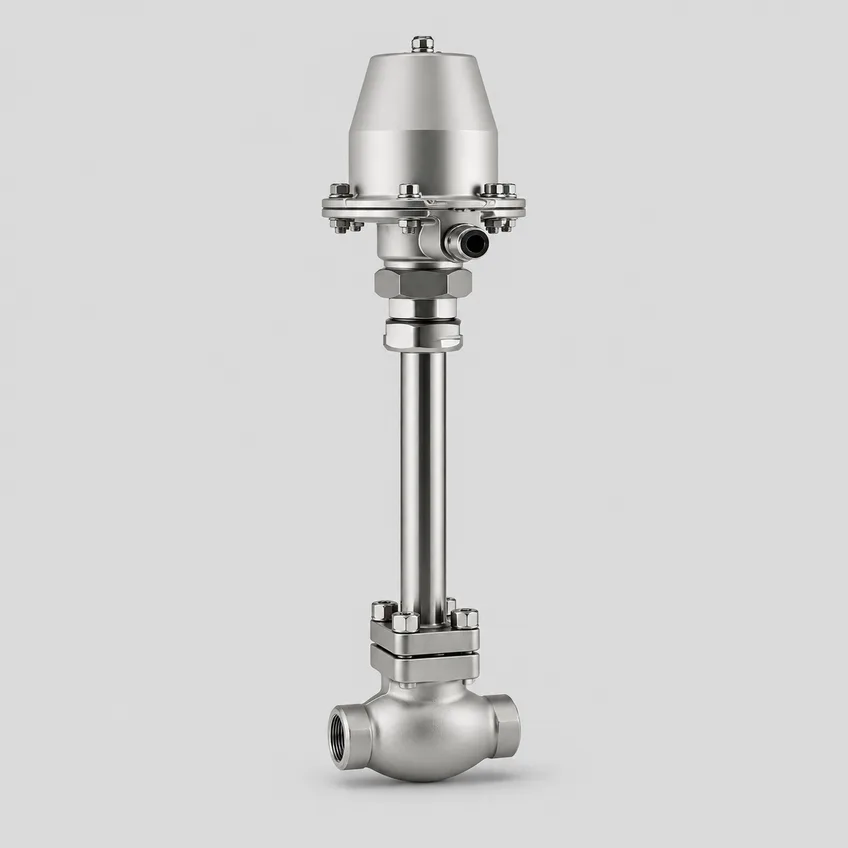
Las válvulas de globo criogénicas son la ejecución de bonete alargado de la línea de globos de acero forjado: el bonete se alarga de modo que la estopada del vástago queda lo bastante lejos de la fuente fría para mantenerse dentro de su rango de temperatura de trabajo, y la construcción de cuerpo y bonete en acero inoxidable F304/F316 conviene al servicio de gas licuado a baja temperatura donde un cuerpo de acero al carbono caería por debajo de sus límites de tenacidad. La ejecución de referencia cubre NPS 1/2 a 2 en paso normal (paso total un tamaño menor) en extremos roscados y de soldadura a enchufe Class 800, más ejecuciones bridadas de extremos generales Class 150/300/600 bajo API 602, AP1602, ASME B16.10 y ASME B16.5.
Parte de la Válvulas de globo de acero forjado familia
Última actualización: 2026-11
Especificaciones
| Valve body material | ASTM A182 F304/F316 with cobalt-chromium hardfacing alloy overlay |
|---|---|
| Bonnet material | ASTM A182 F304/F316 |
| Disc Materials | ASTM A182 F304/F316 with cobalt-chromium hardfacing alloy overlay |
| stem nut materials | Bronze |
| yoke materials | ASTM A182 F304/F316 with cobalt-chromium hardfacing alloy overlay |
| gland flange materials | ASTM A351 CF8 |
| handwheel materials | Ductile iron |
| gland materials | ASTM A276 304/316 |
| Stem material | ASTM A182 F304/F316 |
| gasket materials | 304/316 SS spiral-wound graphite |
| bolt materials | ASTM A320 B8 CL2 |
| Packing Materials | Ductile iron (as printed in the benchmark material list) |
| handwheel nut materials | ASTM A276 304 |
| washer materials | ASTM A276 304 |
| stud materials | ASTM A193 B8 |
| nut materials | ASTM A194 8 |
| name plate materials | ASTM A276 304 |
| screw materials | ISO 3506 A1-50 |
| direction sign materials | ASTM A276 304 |
| end to end class800 bolted bonnet | NPS 1/2: 76 mm | NPS 3/4: 86 mm | NPS 1: 102 mm | NPS 1-1/4: 140 mm | NPS 1-1/2: 140 mm | NPS 2: 170 mm (end-to-end length, Class 800 bolted bonnet cryogenic extended-bonnet execution, regular port size, full port one size smaller, threaded and socket weld ends, AP1602/API 602) |
| bore diameter class800 bolted bonnet | NPS 1/2: 9.5 mm | NPS 3/4: 12.7 mm | NPS 1: 17.5 mm | NPS 1-1/4: 23 mm | NPS 1-1/2: 28.6 mm | NPS 2: 36.5 mm (bore diameter, Class 800 bolted bonnet cryogenic extended-bonnet execution, regular port size, full port one size smaller) |
| center to top open class800 bolted bonnet | NPS 1/2: 394.3 mm | NPS 1: 470.3 mm | NPS 1-1/2: 537.8 mm | NPS 2: 569.8 mm (center-to-top (open) height, Class 800 bolted bonnet cryogenic extended-bonnet execution, regular port size, full port one size smaller; NPS 3/4 and 1-1/4 omitted (printed mm/in pair internally inconsistent, excluded fail-closed)) |
| handwheel class800 bolted bonnet | NPS 1/2: 90 mm | NPS 3/4: 110 mm | NPS 1: 150 mm | NPS 1-1/4: 150 mm | NPS 1-1/2: 180 mm | NPS 2: 180 mm (handwheel diameter, Class 800 bolted bonnet cryogenic extended-bonnet execution, regular port size, full port one size smaller) |
| weight class800 bolted bonnet | NPS 1/2: 3 kg | NPS 3/4: 3.5 kg | NPS 1: 6 kg | NPS 1-1/4: 9 kg | NPS 1-1/2: 10.5 kg | NPS 2: 15.5 kg (approximate weight, Class 800 bolted bonnet cryogenic extended-bonnet execution, regular port size, full port one size smaller) |
| end to end class150 overall end flange | NPS 1/2: 108 mm | NPS 3/4: 117 mm | NPS 1: 127 mm | NPS 1-1/2: 165 mm | NPS 2: 203 mm (end-to-end length, Class 150 overall-end flange) |
| end to end class300 overall end flange | NPS 1/2: 152 mm | NPS 3/4: 178 mm | NPS 1: 203 mm | NPS 1-1/2: 229 mm | NPS 2: 267 mm (end-to-end length, Class 300 overall-end flange) |
| end to end class600 overall end flange | NPS 1/2: 165 mm | NPS 3/4: 190 mm | NPS 1: 216 mm | NPS 1-1/2: 241 mm | NPS 2: 292 mm (end-to-end length, Class 600 overall-end flange) |
| bore diameter class150 300 600 overall end flange | NPS 1/2: 9.5 mm | NPS 3/4: 12.7 mm | NPS 1: 17.5 mm | NPS 1-1/2: 28.6 mm | NPS 2: 36.5 mm (bore diameter, Class 150/300/600 overall-end flange, bolted bonnet, cryogenic extended-bonnet execution, regular port, ASME B16.10/B16.5) |
| center to top open class150 300 600 overall end flange | NPS 1/2: 394.3 mm | NPS 3/4: 416.7 mm | NPS 1: 470.3 mm | NPS 1-1/2: 537.8 mm | NPS 2: 569.8 mm (center-to-top (open) height, Class 150/300/600 overall-end flange, bolted bonnet, cryogenic extended-bonnet execution, regular port, ASME B16.10/B16.5) |
| handwheel class150 300 600 overall end flange | NPS 1/2: 90 mm | NPS 3/4: 110 mm | NPS 1: 150 mm | NPS 1-1/2: 180 mm | NPS 2: 180 mm (handwheel diameter, Class 150/300/600 overall-end flange, bolted bonnet, cryogenic extended-bonnet execution, regular port, ASME B16.10/B16.5) |
| weight class150 overall end flange | NPS 1/2: 5 kg | NPS 3/4: 6 kg | NPS 1: 7.5 kg | NPS 1-1/2: 15 kg | NPS 2: 20 kg (approximate weight, Class 150 overall-end flange) |
| weight class300 overall end flange | NPS 1/2: 5.6 kg | NPS 3/4: 7.5 kg | NPS 1: 8.3 kg | NPS 1-1/2: 16.5 kg | NPS 2: 22 kg (approximate weight, Class 300 overall-end flange) |
| weight class600 overall end flange | NPS 1/2: 6.1 kg | NPS 3/4: 7.8 kg | NPS 1: 9.1 kg | NPS 1-1/2: 18 kg | NPS 2: 24 kg (approximate weight, Class 600 overall-end flange) |
| size range asme | NPS 1/2, 3/4, 1, 1-1/4, 1-1/2, 2 (regular port; full port one size smaller) |
| Pressure class / nominal rating designation | Class 800 (threaded and socket weld ends); Class 150, Class 300, Class 600 (overall-end flange) |
| Design standards | API 602 (compact forged execution, regular port), AP1602 (regular and full port), ASME B16.10 (structure length, overall-end flange), ASME B16.5 (overall-end flange), Extended bonnet cryogenic execution |
| stem type | Outside screw and yoke (OS&Y) |
| bonnet connection | Bolted bonnet (both Class 800 and overall-end flange executions) |
| End connection types | Threaded and socket weld ends (Class 800); overall-end flange (Class 150/300/600) |
Orientación de aplicación y selección
Select this execution when the medium is a liquefied gas or other low-temperature service and shut-off throttling discipline of a globe pattern is required: the extended bonnet keeps the packing zone warm, the F304/F316 material list keeps the pressure boundary tough at low temperature, and the Class 800 threaded/socket-weld execution covers compact high-pressure lines while the Class 150/300/600 overall-end flange executions cover flanged plant pipework. Confirm the design temperature and medium against the project specification at RFQ, since the benchmark material list fixes the construction but not the certified temperature class.
Preguntas frecuentes
Why does a cryogenic globe valve have an extended bonnet?
The extended bonnet lengthens the stem column so the packing and gland sit above the cold source, outside the zone that the cold medium cools below sealing temperature. In the benchmark dimension tables the center-to-top (open) height reaches about 394 to 570 mm across NPS 1/2 to 2, which is the physical expression of that extended column compared with a compact forged globe of the same bore.
Which sizes, ends and pressure classes does this execution cover?
The benchmark execution covers NPS 1/2 to 2 in regular port (full port one size smaller). Class 800 is bolted bonnet with threaded and socket weld ends under AP1602/API 602; Class 150, 300 and 600 are bolted bonnet overall-end flange executions with structure length to ASME B16.10 and flange dimensions to ASME B16.5.
What materials does the benchmark cryogenic globe use?
The benchmark material list is stainless throughout the pressure boundary: ASTM A182 F304/F316 body, bonnet, disc, yoke and stem with cobalt-chromium hardfacing alloy overlay on seating faces, a 304/316 SS spiral-wound graphite gasket, ASTM A320 B8 CL2 bolts and A193 B8 studs, and bronze stem nut with ductile iron handwheel. Confirm the exact material trim against the project specification at RFQ.
Pedido y documentación
Documentos
Solicite con la consulta el conjunto documental que necesite — los elementos habituales para esta ejecución (certificados de material, informes de ensayo según la norma de inspección indicada, planos dimensionales) se confirman y entregan con la cotización.
Cotización
Una consulta lista para cotizar indica: medida nominal y clase de presión, preferencia de materiales del cuerpo y del asiento, conexión terminal, accionamiento, y el fluido de servicio con su temperatura. Los valores típicos de esta página son rangos de referencia; los valores vinculantes se confirman en la cotización.
Muestra y suministro
Las condiciones de suministro, cantidades pedidas y plazos se acuerdan por pedido — indique el país de destino y el calendario requerido con la consulta.
Almacenamiento y envío
Almacene las válvulas con asientos y sellos protegidos de UV, ozono y deformación, mantenga los protectores de cara terminal hasta la instalación y, en ejecuciones con asiento de elastómero o PTFE, evite el almacenamiento prolongado a la intemperie — los compuestos de asiento envejecen más rápido al sol directo y en condiciones de congelación.
Solicitar presupuesto para Válvulas de globo criogénicas
Envíe aquí el requerimiento de esta ejecución — una consulta lista para cotizar indica los parámetros listados bajo el campo de mensaje; los valores vinculantes se confirman en la cotización.
Lo que ocurre con sus datos está descrito en nuestro aviso de privacidad.
Obtener un presupuesto para Válvulas de globo criogénicas
Envíe la medida, la clase de presión y los materiales para una consulta lista para cotizar — respuesta con documentación y condiciones.
Solicitar presupuesto