
Valvole a globo · Valvole a globo in acciaio forgiato
Valvole a globo criogeniche
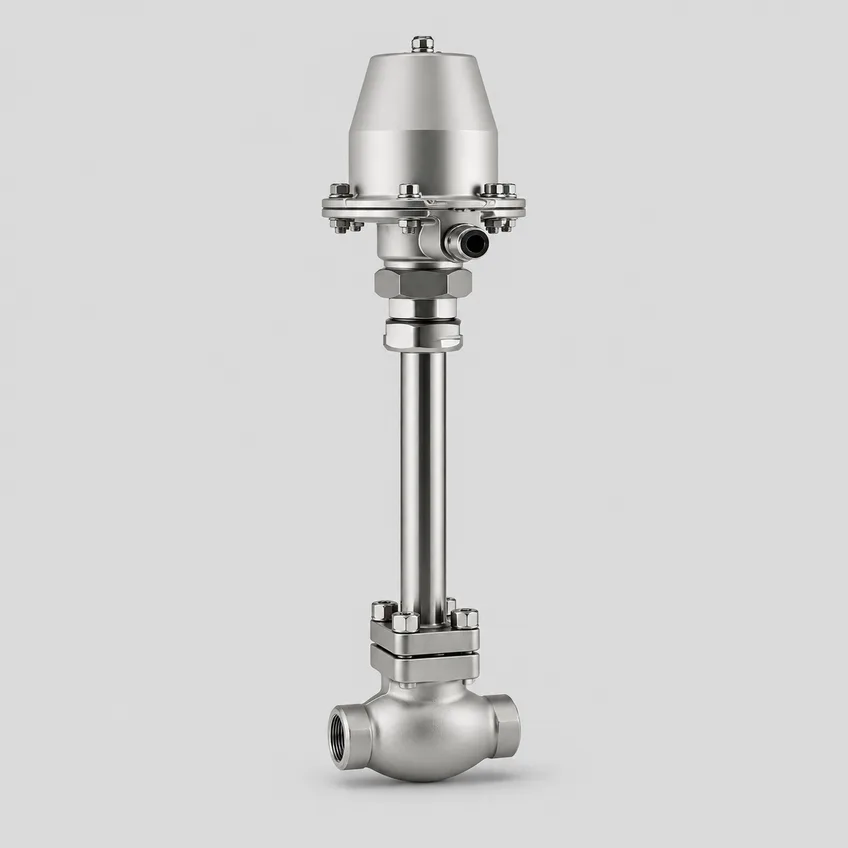
Le valvole a globo criogeniche sono l'esecuzione a cappello prolungato della linea dei globi in acciaio forgiato: il cappello è allungato così che la stoppa dello stelo resta abbastanza lontana dalla fonte fredda per stare entro il suo intervallo di temperatura di lavoro, e la costruzione di corpo e cappello in acciaio inossidabile F304/F316 si addice al servizio gas liquefatto bassa temperatura dove un corpo in acciaio al carbonio cadrebbe sotto i suoi limiti di tenacità. L'esecuzione di riferimento copre da NPS 1/2 a 2 a passaggio normale (passaggio totale una dimensione inferiore) in attacchi filettati e saldatura a bussola Class 800, più esecuzioni flangiate ad attacchi generali Class 150/300/600 secondo API 602, AP1602, ASME B16.10 e ASME B16.5.
Fa parte della Valvole a globo in acciaio forgiato famiglia
Ultimo aggiornamento: 2026-11
Specifiche
| Valve body material | ASTM A182 F304/F316 with cobalt-chromium hardfacing alloy overlay |
|---|---|
| Bonnet material | ASTM A182 F304/F316 |
| Disc Materials | ASTM A182 F304/F316 with cobalt-chromium hardfacing alloy overlay |
| stem nut materials | Bronze |
| yoke materials | ASTM A182 F304/F316 with cobalt-chromium hardfacing alloy overlay |
| gland flange materials | ASTM A351 CF8 |
| handwheel materials | Ductile iron |
| gland materials | ASTM A276 304/316 |
| Stem material | ASTM A182 F304/F316 |
| gasket materials | 304/316 SS spiral-wound graphite |
| bolt materials | ASTM A320 B8 CL2 |
| Packing Materials | Ductile iron (as printed in the benchmark material list) |
| handwheel nut materials | ASTM A276 304 |
| washer materials | ASTM A276 304 |
| stud materials | ASTM A193 B8 |
| nut materials | ASTM A194 8 |
| name plate materials | ASTM A276 304 |
| screw materials | ISO 3506 A1-50 |
| direction sign materials | ASTM A276 304 |
| end to end class800 bolted bonnet | NPS 1/2: 76 mm | NPS 3/4: 86 mm | NPS 1: 102 mm | NPS 1-1/4: 140 mm | NPS 1-1/2: 140 mm | NPS 2: 170 mm (end-to-end length, Class 800 bolted bonnet cryogenic extended-bonnet execution, regular port size, full port one size smaller, threaded and socket weld ends, AP1602/API 602) |
| bore diameter class800 bolted bonnet | NPS 1/2: 9.5 mm | NPS 3/4: 12.7 mm | NPS 1: 17.5 mm | NPS 1-1/4: 23 mm | NPS 1-1/2: 28.6 mm | NPS 2: 36.5 mm (bore diameter, Class 800 bolted bonnet cryogenic extended-bonnet execution, regular port size, full port one size smaller) |
| center to top open class800 bolted bonnet | NPS 1/2: 394.3 mm | NPS 1: 470.3 mm | NPS 1-1/2: 537.8 mm | NPS 2: 569.8 mm (center-to-top (open) height, Class 800 bolted bonnet cryogenic extended-bonnet execution, regular port size, full port one size smaller; NPS 3/4 and 1-1/4 omitted (printed mm/in pair internally inconsistent, excluded fail-closed)) |
| handwheel class800 bolted bonnet | NPS 1/2: 90 mm | NPS 3/4: 110 mm | NPS 1: 150 mm | NPS 1-1/4: 150 mm | NPS 1-1/2: 180 mm | NPS 2: 180 mm (handwheel diameter, Class 800 bolted bonnet cryogenic extended-bonnet execution, regular port size, full port one size smaller) |
| weight class800 bolted bonnet | NPS 1/2: 3 kg | NPS 3/4: 3.5 kg | NPS 1: 6 kg | NPS 1-1/4: 9 kg | NPS 1-1/2: 10.5 kg | NPS 2: 15.5 kg (approximate weight, Class 800 bolted bonnet cryogenic extended-bonnet execution, regular port size, full port one size smaller) |
| end to end class150 overall end flange | NPS 1/2: 108 mm | NPS 3/4: 117 mm | NPS 1: 127 mm | NPS 1-1/2: 165 mm | NPS 2: 203 mm (end-to-end length, Class 150 overall-end flange) |
| end to end class300 overall end flange | NPS 1/2: 152 mm | NPS 3/4: 178 mm | NPS 1: 203 mm | NPS 1-1/2: 229 mm | NPS 2: 267 mm (end-to-end length, Class 300 overall-end flange) |
| end to end class600 overall end flange | NPS 1/2: 165 mm | NPS 3/4: 190 mm | NPS 1: 216 mm | NPS 1-1/2: 241 mm | NPS 2: 292 mm (end-to-end length, Class 600 overall-end flange) |
| bore diameter class150 300 600 overall end flange | NPS 1/2: 9.5 mm | NPS 3/4: 12.7 mm | NPS 1: 17.5 mm | NPS 1-1/2: 28.6 mm | NPS 2: 36.5 mm (bore diameter, Class 150/300/600 overall-end flange, bolted bonnet, cryogenic extended-bonnet execution, regular port, ASME B16.10/B16.5) |
| center to top open class150 300 600 overall end flange | NPS 1/2: 394.3 mm | NPS 3/4: 416.7 mm | NPS 1: 470.3 mm | NPS 1-1/2: 537.8 mm | NPS 2: 569.8 mm (center-to-top (open) height, Class 150/300/600 overall-end flange, bolted bonnet, cryogenic extended-bonnet execution, regular port, ASME B16.10/B16.5) |
| handwheel class150 300 600 overall end flange | NPS 1/2: 90 mm | NPS 3/4: 110 mm | NPS 1: 150 mm | NPS 1-1/2: 180 mm | NPS 2: 180 mm (handwheel diameter, Class 150/300/600 overall-end flange, bolted bonnet, cryogenic extended-bonnet execution, regular port, ASME B16.10/B16.5) |
| weight class150 overall end flange | NPS 1/2: 5 kg | NPS 3/4: 6 kg | NPS 1: 7.5 kg | NPS 1-1/2: 15 kg | NPS 2: 20 kg (approximate weight, Class 150 overall-end flange) |
| weight class300 overall end flange | NPS 1/2: 5.6 kg | NPS 3/4: 7.5 kg | NPS 1: 8.3 kg | NPS 1-1/2: 16.5 kg | NPS 2: 22 kg (approximate weight, Class 300 overall-end flange) |
| weight class600 overall end flange | NPS 1/2: 6.1 kg | NPS 3/4: 7.8 kg | NPS 1: 9.1 kg | NPS 1-1/2: 18 kg | NPS 2: 24 kg (approximate weight, Class 600 overall-end flange) |
| size range asme | NPS 1/2, 3/4, 1, 1-1/4, 1-1/2, 2 (regular port; full port one size smaller) |
| Pressure class / nominal rating designation | Class 800 (threaded and socket weld ends); Class 150, Class 300, Class 600 (overall-end flange) |
| Design standards | API 602 (compact forged execution, regular port), AP1602 (regular and full port), ASME B16.10 (structure length, overall-end flange), ASME B16.5 (overall-end flange), Extended bonnet cryogenic execution |
| stem type | Outside screw and yoke (OS&Y) |
| bonnet connection | Bolted bonnet (both Class 800 and overall-end flange executions) |
| End connection types | Threaded and socket weld ends (Class 800); overall-end flange (Class 150/300/600) |
Indicazioni di applicazione e selezione
Select this execution when the medium is a liquefied gas or other low-temperature service and shut-off throttling discipline of a globe pattern is required: the extended bonnet keeps the packing zone warm, the F304/F316 material list keeps the pressure boundary tough at low temperature, and the Class 800 threaded/socket-weld execution covers compact high-pressure lines while the Class 150/300/600 overall-end flange executions cover flanged plant pipework. Confirm the design temperature and medium against the project specification at RFQ, since the benchmark material list fixes the construction but not the certified temperature class.
Domande frequenti
Why does a cryogenic globe valve have an extended bonnet?
The extended bonnet lengthens the stem column so the packing and gland sit above the cold source, outside the zone that the cold medium cools below sealing temperature. In the benchmark dimension tables the center-to-top (open) height reaches about 394 to 570 mm across NPS 1/2 to 2, which is the physical expression of that extended column compared with a compact forged globe of the same bore.
Which sizes, ends and pressure classes does this execution cover?
The benchmark execution covers NPS 1/2 to 2 in regular port (full port one size smaller). Class 800 is bolted bonnet with threaded and socket weld ends under AP1602/API 602; Class 150, 300 and 600 are bolted bonnet overall-end flange executions with structure length to ASME B16.10 and flange dimensions to ASME B16.5.
What materials does the benchmark cryogenic globe use?
The benchmark material list is stainless throughout the pressure boundary: ASTM A182 F304/F316 body, bonnet, disc, yoke and stem with cobalt-chromium hardfacing alloy overlay on seating faces, a 304/316 SS spiral-wound graphite gasket, ASTM A320 B8 CL2 bolts and A193 B8 studs, and bronze stem nut with ductile iron handwheel. Confirm the exact material trim against the project specification at RFQ.
Ordinazione e documentazione
Documenti
Chiedi con la richiesta il pacchetto di documentazione che ti serve — gli elementi tipici per questa esecuzione (certificati dei materiali, rapporti di prova secondo la norma di ispezione indicata, disegni dimensionali) vengono confermati e forniti con il preventivo.
Preventivo
Una richiesta pronta per il preventivo indica: dimensione nominale e classe di pressione, preferenza di materiali del corpo e della sede, collegamento finale, azionamento, e il fluido di servizio con la sua temperatura. I valori tipici di questa pagina sono gamme di riferimento; i valori vincolanti vengono confermati in fase di preventivo.
Campione e fornitura
Condizioni di fornitura, quantità ordinate e tempi di consegna sono concordati per ordinativo — indica il paese di destinazione e il calendario richiesto con la richiesta.
Stoccaggio e spedizione
Conserva le valvole con sedi e tenute protette da UV, ozono e deformazione, mantieni le protezioni delle facce di tenuta fino all'installazione e, per le esecuzioni con sede in elastomero o PTFE, evita lo stoccaggio prolungato all'aperto — i composti delle sedi invecchiano più rapidamente al sole diretto e al gelo.
Richiedi un preventivo per Valvole a globo criogeniche
Invia qui l'esigenza per questa esecuzione — una richiesta pronta per il preventivo indica i parametri elencati sotto il campo messaggio; i valori vincolanti vengono confermati in fase di preventivo.
Cosa accade ai tuoi dati è descritto nell'informativa sulla privacy.
Ottieni un preventivo per Valvole a globo criogeniche
Invia dimensione, classe di pressione e materiali per una richiesta pronta per il preventivo — risposta con documenti e condizioni.
Richiedi un preventivo